SIGOURNEY WEAVER: The Queen of ’80s Sci-Fi — Ripley, Zuul and the Gen-X Sex Symbol Who Changed the Genre

SIGOURNEY WEAVER: The Queen of ’80s Sci-Fi — Ripley, Zuul and the Gen-X Sex Symbol Who Changed the Genre
There is a reason a generation can hear the name Sigourney Weaver and immediately picture steam rolling through a steel corridor, the warning lights of LV-426, or a Manhattan apartment glowing like the doorway to another dimension. Weaver did more than star in some of the biggest genre movies of the 1980s. She made intelligence, nerve and authority part of the decade’s sex appeal.

Ripley Was Never Designed as a “Female Action Hero”
Technically, Ellen Ripley first walked aboard the Nostromo in 1979’s Alien, but Ripley became an unquestioned 1980s icon with James Cameron’s Aliens in 1986. One of the strangest facts about the character goes all the way back to the original Alien screenplay: the major roles were not assigned a specific gender. Ripley did not begin on the page as Hollywood’s idea of a “female action hero.” Weaver simply made the character her own. Even more surprising, she arrived late to her Alien audition after going to the wrong hotel.
By the time Aliens went into development, Cameron considered Weaver essential. Fox did not initially see things the same way. The studio worried that Weaver’s involvement would give her representatives too much bargaining power, and Cameron and producer Gale Anne Hurd pushed hard to keep her at the center of the sequel. Cameron later said making the movie without her was out of the question.
That fight mattered, because Aliens transformed Ripley from survivor into something audiences had almost never seen: a woman who could carry a massive action picture without being written as a male hero in disguise. Weaver brought fear, anger, tenderness and physical toughness to the role. The performance was so respected that the Academy nominated her for Best Actress — a rare achievement for a science-fiction action performance.
There was another wrinkle behind the scenes. According to accounts from The Making of Aliens, Weaver was uncomfortable with the film’s heavy emphasis on firearms and jokingly referred to her new action-heavy version of Ripley as “Rambolina.” Cameron had to ground the action in Ripley’s motivation: she was not shooting because she loved weapons; she was trying to save Newt. That distinction is one reason the performance still feels human underneath all the pulse rifles and flamethrowers.
Then Came Dana Barrett — And Zuul
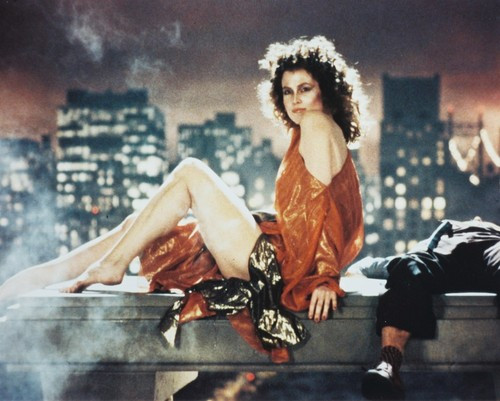
Ghostbusters gave 1984 audiences a completely different Weaver: sophisticated, dryly funny, romantic and — once Dana is possessed by Zuul — deliberately seductive. The flowing copper-red dress, wild hair and smoky supernatural lighting created one of the decade’s most memorable fantasy images. For many Gen-X viewers, Weaver’s appeal came precisely from that contrast. She could be glamorous without seeming ornamental, sexy without surrendering the intelligence that made her characters interesting.
And her Ghostbusters audition was almost as wild as the finished movie. Weaver later recalled deciding to demonstrate how Dana should transform into a Terror Dog. She growled, howled, jumped around on a couch and attacked a cushion until director Ivan Reitman stopped the camera. The bizarre choice helped convince him she understood the film’s strange mixture of horror and comedy.
Weaver also helped reshape Dana herself. The character had originally been conceived as a model. Weaver suggested making her a cellist instead, believing the music would reveal a more interesting inner life. It is a tiny change, but it tells you almost everything about how she approached her roles: even in a movie involving slime, proton packs and a giant marshmallow man, she wanted the woman she played to feel real.
The Gen-X Sex Symbol Who Never Had to Play Dumb

By Ghostbusters II in 1989, Weaver was no longer simply “the woman from Alien.” She was one of the faces of an entire era of genre filmmaking. That same period also brought acclaimed dramatic work in Gorillas in the Mist and Working Girl, proving that the woman fighting xenomorphs and flirting with Peter Venkman could move effortlessly into prestige drama and comedy.
That may be the secret behind Weaver’s lasting status as a Gen-X sex symbol. Hollywood did not have to make Ripley foolish to make her attractive. Dana did not have to lose her intelligence to become sensual. Weaver could walk into a scene looking frightened, irritated, amused or completely in command, and all of it felt authentic.
For Gen X, the images remain wonderfully permanent: Ripley gripping a pulse rifle, Dana opening the door as Zuul, Weaver staring down something impossible with that mixture of fear and confidence.
The monsters changed. The worlds changed. Sigourney Weaver owned every one of them.